


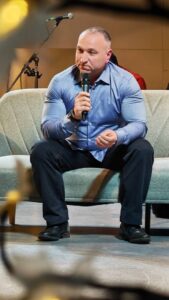
 The Director of the Bulgarian Entrepreneurship Centre Foundation Lilly Drumeva-O’Reilly spoke on Darik Radio with Georgi Levicharov of the Equal Start 2008 Association in Gabrovo: https://ravenstart.com/
– What is your background, and what inspired you to create this programme?
My name is Georgi Levicharov. I am a kinesiotherapist and swimming coach based in the city of Gabrovo. I have been working with children and young people with intellectual and physical disabilities for 13–14 years.
We started with aquatic rehabilitation and adapted swimming as part of a project run by the Equal Start 2008 Association. At the time, I attended an introductory training course in Sofia organised by the Water Path Foundation. I became familiar with this type of work, found it rewarding, and decided to develop it in Gabrovo.
The idea of establishing a sports and therapy centre first emerged around seven or eight years ago. It had been a long-standing dream of mine. Parents who brought their children to swimming lessons often told me how difficult it was to find other sporting activities where their children would be welcomed. I have heard them say: “It’s a good thing you’re here to take my child. Nobody wants them in any other sport.”
This made me realize how great the need was for a place where children with disabilities could take part in sports and receive the therapeutic support they need.
We have been working to make this idea a reality for the past two years, and since the beginning of 2026, the sports and therapy centre has been fully operational. It combines sports and therapy and is the first centre of its kind in Bulgaria.
– Could you tell us more about the program, the activities it offers, and the people it serves?
The sports and therapy centre run by the Equal Start 2008 Association is designed for children and young people with intellectual and physical disabilities. Our main idea is to combine sporting activities with therapeutic work, so that children can receive comprehensive support in one place. We offer a range of sports, including football, basketball, volleyball, badminton, table tennis and adapted physical activities. We also have a fully equipped gym tailored to the children’s abilities and needs.
In addition to sports, we offer occupational therapy, speech and language therapy, psychological support and educational assistance. We work with children with cerebral palsy, autism spectrum disorders, physical disabilities and other developmental difficulties.
Our goal is to help them develop their motor, cognitive and social skills, become more independent, and enjoy the opportunity to take part in sports just like other children.
– What does your team look like? Where do the activities take place, and how many children are currently involved?
Our activities take place at our sports and therapy centre in Gabrovo, while aquatic rehabilitation and adapted swimming sessions are held at a swimming pool. Our team includes a range of specialists: a kinesiotherapist, an occupational therapist, a speech and language therapist, a psychologist, an educator and a social worker.
We also rely on volunteers from local sports clubs in Gabrovo. Dimitar Todorov from Chardafon Basketball Club leads basketball training sessions; Nikolay Grigorov from Koko Volley takes part in the volleyball activities; and Georgi Nikolov and Martin Todorinov from the youth academy of Yantra Football Club join the football sessions.
We currently work with 40 children, although the centre was initially designed to accommodate 20. The interest has been greater than expected, so we decided to double the number of children we accept.
– I personally visited your centre and was impressed by how carefully the documentation for each child is organized. How do you assess the children’s progress throughout the program? Could you share some success stories?
We keep individual records for every child, including an assessment of their needs and an individual support plan. We also have a social worker who oversees the documentation and individual case files. Each child’s development is monitored individually because every child has different abilities and needs. For some, the adaptation process takes several months, and sometimes even a year. But we work consistently and never give up.
The results speak for themselves. We have children who were initially afraid even of a ball. Today, they can navigate between cones, dribble, kick a football and are learning to shoot into a basketball hoop.
These may seem like small victories to us, but they are extremely important milestones in the children’s development.
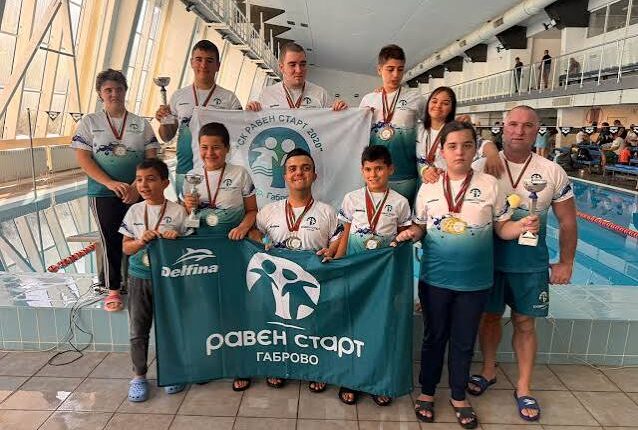
We also have children who started with aquatic rehabilitation, gradually progressed to adapted swimming and are now competing in national and international competitions. But for us, success is not measured by medals alone. What matters is that every child makes progress according to their own abilities.
– As a swimming coach, what skills does swimming help develop? Why is it particularly suitable for people with disabilities?
The aquatic environment is particularly beneficial for people with physical disabilities. We make use of the buoyancy of water, which makes the body feel lighter and allows movements to be performed more easily. This enables children to perform movements that may be difficult for them on land. Aquatic rehabilitation helps improve coordination, muscle strength, motor control and breathing.
For some children on the autism spectrum, water has a calming effect, although the adaptation process varies from child to child and can sometimes take quite a long time. So we proceed gradually, first building trust and helping the children become comfortable in the water. Only then do we move on to developing swimming skills.
We have children who started with aquatic rehabilitation and are now competitive swimmers, winning medals at international championships.
– You are preparing a major fundraising event – a charity concert on 17 December at Vazrazhdane Hall in Gabrovo. Could you tell us more about it?
On 17 December at 6:00 pm, we are organizing a charity concert at Vazrazhdane Hall in Gabrovo under the motto “Because Every Child Is Someone’s Whole Sky”. The event will feature numerous performers, musical groups and dance ensembles who are supporting our cause.
From 12 to 20 December, we will also organize a Christmas charity market at Vazrazhdane Square. It will offer handmade items donated by parents of children with disabilities, local artists and others who want to support us.
The funds raised will be used to support the activities of our sports and therapy centre. We hope that as many people as possible will join us and support our cause.
– What does the Equal Start program need in order to continue growing – financial resources, specialists, better facilities or publicity?
Our greatest challenge is funding. We are currently managing with the resources available to us, but working with children and young people with disabilities involves ongoing expenses. We need sustainable funding because the specialists working with the children must be paid, while the equipment and facilities need regular maintenance.
Our hope is that, in the future, our activities will receive support through an appropriate government funding mechanism.
We also need larger premises because interest in the centre is considerable. Our dream is to have our own, more spacious facility and additional specialized equipment. Of course, we also need the support of individuals, businesses and institutions so that we can continue developing our work.
– Do you work with other institutions in Gabrovo? Do you have plans to expand the program or open a centre in Sofia?
We have a very good working relationship with the Municipality of Gabrovo, which provided us with premises for the sports and therapy centre. This was an extremely important contribution to making our idea a reality. We also work with local sports clubs, whose coaches volunteer their time to take part in activities with the children. We maintain partnerships with organizations in Sofia as well, including the Water Path Foundation and ParaKids. Together, we take part in international competitions and put together Bulgarian teams.
At this stage, our main priority is to develop the centre in Gabrovo. We want to expand the range of sporting activities and reach more children.
There are already organizations in Sofia working in this field. For us, it is more important to develop opportunities here in Gabrovo, where the need for such activities is considerable.
– For those listening to us who would like to enrol their child in the program, where can they find you?
Parents can contact the Equal Start 2008 Association through our Facebook page or visit the sports and therapy centre in Gabrovo. Any parent who would like their child to take part in our activities is welcome to get in touch. We will arrange a conversation, learn about the child’s needs and discuss the possibilities for their participation.
– Some of the children in your program have won medals at major sporting events. Could you tell us more about their achievements?
Over the years, our children and young people have achieved very good results in national and international competitions.
In 2023, one of our athletes competed at the Special Olympics World Games in Berlin and achieved an honorable sixth-place finish. We have also won third place in the butterfly event at the World Dwarf Games. Among our athletes with international achievements are Ivelin Gramatikov and Grigor Sanchev.
We also participate in the international Emil Open Games in Brno, Czech Republic, where we put together Bulgarian teams in cooperation with our colleagues from the Water Path Foundation and ParaKids. At our most recent participation, the Bulgarian team returned with a total of 18 medals.
We also took part in the Belgrade Cup, from which we likewise returned with numerous medals. These achievements mean a great deal to us because behind every one of them are years of hard work, perseverance and support from the families.
I would like to express my heartfelt gratitude to the parents. Without their support, none of what we have accomplished here in Gabrovo would have been possible.
Parents of children with disabilities are heroes. Every day, they struggle with the system, their own anxieties and the challenges of raising their children. Kudos to them, and I thank them for entrusting their children to our care.
Recent Comments